






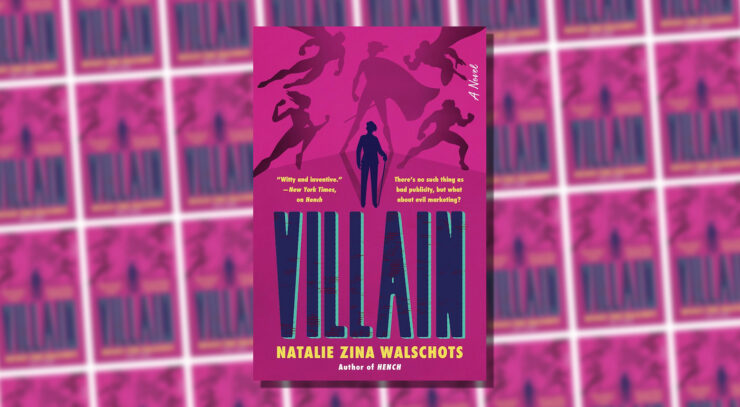
Villain, the long-awaited sequel to Natalie Zina Walshots’ Hench is here. In it, we’re brought back into a world not dissimilar to The Boys, where corporatized super-powered people exist and the good guys are kinda terrible.
On the “hero” side is The Draft, a conglomerate that manages teams of superheroes that, as we saw in the first book, cause more harm than good, especially to our main character, Anna/the Auditor. On the other side are the villains. They run their own shops, with the top-tier ones having their own locked-down campuses where they plot against their nemeses. The animosity between the two groups is real, and their battlefields are not only on the streets (where civilians often get hurt) but also on social media, talk shows, and other marketing channels.
Villain is very much a sequel, and like most sequels, not a book to jump into without reading Hench. For those who would like a refresher, Hench chronicles how Anna, a lowly temp worker hired by a mid-tier villain, gets seriously injured by the superhero, Supercollider. That injury got her fired.
The supervillain Leviathan, however, saw her potential: Anna is amazing at data analysis, a wizard with a spreadsheet, and the Injury Report she whipped up at her old gig made Leviathan’s mandibles quiver. That analysis concludes that The Draft causes more harm than good. Add in Anna’s smoldering hatred for Supercollider specifically and superheroes in general, and the supervillain saw the damage she could do. The rest of the first novel sees Anna turn into the Auditor, her evil-doing persona, rescue Leviathan from The Draft and, with the help of Quantum Entanglement—a superhero who has her own reasons to hate Supercollider—spearhead a rather definitive defeat of the planet’s greatest superhero.
Villain starts out a few months after that, with the Auditor (don’t you dare call her Anna anymore) serving as Leviathan’s right hand as the supervillain recovers from his grief over Supercollider, because hate is an intimate emotion and oh-so-close to other feelings. The Auditor is also changed, as she acknowledges to herself many times throughout the book: Anna is but a memory, and Villain sees her move farther and farther away from who she was. Her closest friends in Hench, for example, the normies June and Greg, barely show up in Villain, and when they do it is a devastating moment that changes the Auditor forever.
Buy the Book

Villain
The enemy for the Auditor remains The Draft. The corporation is the embodiment of dehumanizing corporate culture, a place that turns its employees into cogs that can be beaten, sacrificed, and discarded at will, and the Auditor wants to burn it to the ground.
(One could arguably describe a villain’s operations similarly, which the Auditor grapples with when her plans come with “acceptable losses.” Does defeating your enemy justifying you becoming your enemy? It’s a question the Auditor skirts around or barrels over, but one I can’t help but think might come to a head for her one day.)
With Supercollider out of the picture, her main antagonist at The Draft is the company’s chief marketing officer, a disturbingly bubbly man who wears t-shirts and cardigans and who goes by the moniker “Mom” for unknown reasons. Mom is… weirdly earnest and has no real life outside of The Draft’s walls. I’d be curious to see through a crack in his “aw shucks” persona to see what’s bubbling underneath.
Mom and the mission to destroy The Draft, however, are secondary in Villain. Where Hench gave us a broader commentary about the many flaws in our corporate-driven world, the sequel focuses more on the Auditor’s internal journey. That’s not to say there isn’t action, but the focus of the story is more on the Auditor’s state of mind and her ever-closer, far-from-cookie-cutter relationship with Leviathan. The bond the two have is laced with fear (on the Auditor’s part) and desire. Unsurprisingly, the two become romantically involved despite the power differential (indeed, the power differential is a core part of it, given their relationship includes BDSM elements). But Leviathan crosses the line with holding that power over the Auditor: He can track her every move without her buy-in or consent and makes villainous plans without cluing her in, often turning her nefarious deeds into truly diabolical actions she never agreed to.
The whole situation, in a word, is not great. And through it all the Auditor is figuring out who she wants to be and whether those choices come from her own agency or are manipulated, even unintentionally, by Leviathan. Quantum Entanglement, with whom the Auditor has another complicated relationship, perhaps voices what many readers might be thinking: She wants the Auditor to leave Leviathan (and, implicitly, be with her), and views the supervillain’s actions as making the Auditor more evil than she “truly” is.
But it’s more complicated than that. The Auditor, she continually tells us, wants her agency and arguably gains it. That agency, from the Auditor’s perspective, led her to choose to do unforgivable things (though, one could argue, she would never have to make certain decisions if Leviathan didn’t force her hand). It might be hard for some readers to stay with the Auditor while she does those things, especially as her actions are so entangled with the romantic relationship she has with her boss. The book ends at more of a turning point—both in the Auditor and Leviathan’s relationship and in the face-off with The Draft—than a resolution. In that sense, Villain feels like a bridge to a third book. How the Auditor turns out in that presumed future, and how she responds to Leviathan and the choices she’s made in Villain, remains to be seen.
Villain is published by William Morrow.
